
The Real Benefits of Epoxy Flooring (And What Determines Whether You Actually Get Them)
We get asked a version of the same question almost every week: “Is epoxy actually worth it, or is it just a garage floor that looks nice for a year and then starts peeling?” It’s a fair question, because both of those floors exist, and the honest answer is that epoxy’s real-world benefits depend almost entirely on the system used and how it’s installed, not just the fact that it’s “epoxy.”
We’ve spent over a decade installing these floors, and we’ve also been called out to look at floors other people installed that didn’t hold up. The difference between a floor that delivers on everything epoxy is supposed to do and one that disappoints a homeowner within two years usually isn’t the marketing brochure, it’s what’s actually happening during prep and cure. Here’s what epoxy flooring genuinely delivers, and just as important, what determines whether you actually get those benefits or not.
Durability That Depends on the System, Not Just the Word "Epoxy"
Epoxy coatings are significantly thicker and harder than a standard garage floor paint, which is why they hold up to vehicle traffic, dropped tools, and daily wear that would chip or peel a painted surface within a season. But “epoxy” isn’t one single product, the durability difference between a big-box DIY kit and a commercial-grade two-part system is enormous, even though both get marketed under the same word.
We install a commercial-grade Sherwin-Williams system, a TileClad epoxy base coat paired with an ArmorSeal Rexthane 1 polyurethane topcoat, the same category of coating system used in environments like water treatment facilities and airport hangars, where a coating failure isn’t cosmetic, it’s a real operational problem. That’s the level of durability a properly specified system is actually capable of. A thin, single-coat DIY kit simply isn’t built to the same standard, regardless of how similar it looks on day one.
Stain and Chemical Resistance — But Only If the Cure Is Right
A properly cured epoxy floor is non-porous, which means oil, coolant, road salt, and most household chemicals sit on top of the surface instead of soaking in, spills wipe up instead of staining. This is one of the most genuinely useful benefits for a garage or shop floor specifically, since bare concrete stains permanently from exactly these kinds of spills.
Here’s the part most explanations of epoxy skip entirely: that chemical resistance depends on the coating fully curing before it’s put to use. Cure time isn’t optional and it isn’t flexible, it’s a chemical process that takes the time it takes. We’ve walked into jobs where a previous contractor’s floor started showing chemical staining and soft spots within months, and the underlying cause almost every time was a topcoat applied before the base coat had properly cured, usually because the whole job was rushed into a single day. We let the base coat cure fully overnight before applying the topcoat, which is why our jobs typically run one to two days instead of a single rushed day, and it’s a big part of why the finished floor performs the way epoxy is supposed to.
Low Maintenance, In Practice
A sealed, seamless epoxy surface doesn’t have the pores and micro-cracks that let dust, grime, and bacteria build up the way untreated concrete does. In practice, that means most epoxy floors stay clean with an occasional sweep and a damp mop, no sealers to reapply, no stripping and waxing, none of the upkeep that comes with other flooring options in a garage or shop environment.
This is also one of the more understated advantages for commercial spaces specifically. A shop or warehouse floor that doesn’t require special maintenance products or scheduled resealing is a real, ongoing cost and time savings, not just a one-time convenience.
Safety Improvements That Are Easy to Underestimate
Two safety benefits come up constantly once a floor is finished, and most people don’t think about either one until they’ve lived with the new floor for a while.
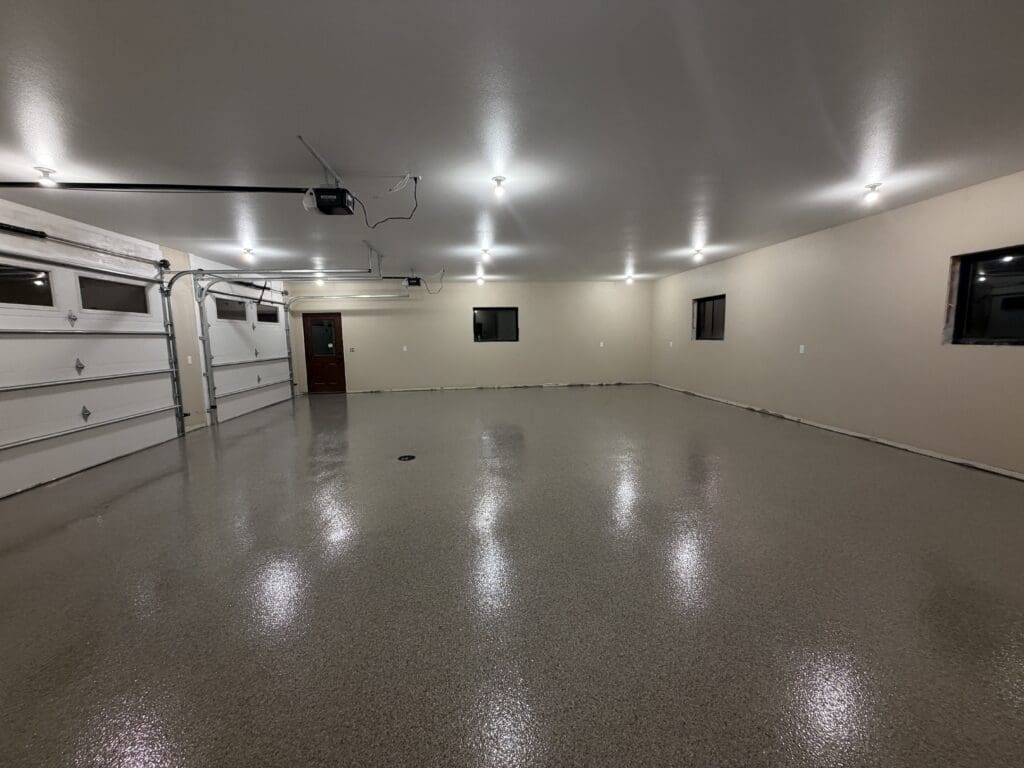
Light reflectivity. A finished epoxy floor reflects significantly more ambient light than bare or painted concrete, which makes a real difference in a garage or shop with standard overhead lighting, the space simply feels brighter without adding a single new light fixture.
Slip resistance. Anti-slip additives can be broadcast into the topcoat during installation, which matters more than people expect in a garage that deals with wet tires, snowmelt, or oil residue tracked in during winter months. This is a spec decision made during the quote process, not something added after the fact, worth discussing upfront if slip resistance matters for how the space gets used.
Long-Term Value, Not Just Upfront Cost
Epoxy flooring is often framed purely as a cosmetic upgrade, but the real financial case is protection. Bare concrete degrades, it dusts, stains, cracks, and absorbs moisture over time, and repairing or resurfacing damaged concrete later is a bigger expense than coating it properly the first time. A quality epoxy system extends the usable life of the existing slab and prevents the kind of gradual damage that’s expensive to fix once it’s set in.
The upfront cost varies by square footage and the system used, a single-bay garage typically starts around $2,500, with larger residential garages and commercial spaces scaling up from there depending on size and prep needs. A free quote is really the only accurate way to know what a specific space will cost, since square footage and existing concrete condition both affect the number significantly.
What Actually Determines Whether You Get These Benefits
This is the part worth remembering more than any individual benefit above: epoxy’s advantages, durability, chemical resistance, low maintenance, safety, long-term value, are all a function of the system and the installation, not a guarantee that comes with the material itself. Two floors can both be called “epoxy” and perform completely differently five years later.
The variables that actually matter are the coating grade, the surface prep, and whether the cure time was respected instead of rushed. If you’re comparing quotes, those are the questions worth asking a contractor directly, not just what color options they offer. You can see our full breakdown of the system and process we use on our services page, or take a look at recent projects to see how these floors actually hold up once they’re finished.
Frequently Asked Questions
What are the main benefits of epoxy flooring?
Epoxy flooring provides significant durability against impact and vehicle traffic, resistance to stains and chemicals, low ongoing maintenance, improved light reflectivity, and long-term protection for the underlying concrete. The extent of each benefit depends heavily on the specific coating system used and the quality of the installation.
Is epoxy flooring actually low maintenance?
Yes, in most cases. A properly cured, sealed epoxy floor doesn’t require sealing, waxing, or special cleaning products, since regular sweeping and occasional mopping is typically sufficient. This is one of the more reliable benefits of epoxy flooring compared to bare or painted concrete.
Does epoxy flooring really resist stains and chemicals?
It does, but only once the coating has fully cured. A properly cured, non-porous epoxy surface resists oil, road salt, and most household chemicals from soaking in. If the topcoat is applied before the base coat has properly cured, which is common with rushed, single-day installs, chemical resistance and overall durability can be significantly compromised.
How long does an epoxy floor need to cure before it delivers these benefits?
A full cure typically requires the base coat to set overnight before a topcoat is applied, which is why a properly installed epoxy floor usually takes one to two days rather than a single day. Rushing this process is one of the most common reasons an epoxy floor underperforms compared to its expected benefits.
Thinking about an epoxy floor for your own garage, shop, or commercial space? Get a free quote and we’ll walk you through exactly what system makes sense for how your space actually gets used.